Showing posts with label Death. Show all posts

Friday, August 06, 2021

TRACTS FOR OUR TIMES - Exploring Christian Faith


Simply written modern Tracts for our Times (some having informed the writing of The Mystery of Faith) which seek to do what it says on the label.  Links to YouTube versions, where available, are provided)

TITLES IN THE SERIES

1.       I Believe in God  (You Tube: https://youtu.be/F-DG9Z_MnDQ)

2.       I Believe in Jesus  (You Tube: https://youtu.be/1QRmD-IdO78)

3.       I Believe in the Holy Spirit (You Tube: https://youtu.be/T8OVQobYyqc)

4.       Deepening Prayer (YouTube: https://youtu.be/RS06Sro6bK8)

5.       The Ministry of Healing  (You Tube https://youtu.be/C3pPPsA7r2Q)

6.       The Sacrament of Confession  (You Tube: https://youtu.be/Je3BvuUr6qs)

7.       Praying for the Departed (You Tube: https://youtu.be/qM-gyh5ruR8)

8.       The Longest Journey – Preparing for Death

9.       Dealing with the death of one we love

10.     Is this a Catholic Church?

11.     Holy Baptism

12.     The Eucharist

13.     First Holy Communion

14.     Reservation of the Blessed Sacrament

15.     Let there be light

16.     A Selection of Prayers and Devotions

17.     The Use of the Body in Prayer

18.     The Use of Incense

19.     Mary and the Saints (You Tube: https://youtu.be/FR1v5oEjVbo)

20.     The Rosary of the Blessed Virgin Mary

21.     Lent, Holy Week and Easter

22.     Traditional Customs and Devotions

_______________________________________

For a fuller exploration:

The Mystery of Faith, Exploring Christian Belief

(This book is intended for individual and group use. It is divided into 8 sections with discussion questions at the end of each.  For those wishing to use it over 6 sessions, a suggested means to do this is available from jff2209@yahoo.com  Please also email for a copy of any of the leaflets shown above)

Sunday, January 17, 2021

PASSING ON

Recently I was told that a neighbour had passed away and was invited to sign a card for his widow. I am sorry for her and the grief she probably feels and will, indeed, sign the card and express support and condolences.

But I do wonder at the term ‘passed away’. I’ve noticed it being increasingly used in place of ‘died’, or ‘passing’ in place of death, and wonder – why the euphemism? Is it that ‘death’ seems so dark and final, the logical, but unspeakable, consequence of not believing that anything comes afterwards – that we simply cease to be? But, if that’s the case, what do we ‘pass on’ to? We speak of passing as a movement from one place to another, or as the opposite of failing as one might an exam, so that we can move on to greater things. But if there is nothing to ‘pass on’ to, isn’t the term meaningless?

The New Testament does, indeed, speak about this ‘passing’ from life to death: (Jesus said) “Very truly, I tell you, anyone who hears my word and believes him who sent me has eternal life, and does not come under judgement, but has passed from death to life” (John 5.24). If there is something to ‘pass on’ to then we can begin to explore what that might be and Christian Faith has much to say about death and dying and how we need to live. I know it goes against the grain of much current Western thinking and can be challenging for many (so best not thought about). But for those who want to listen and, maybe, learn, Jesus has much wisdom to offer.

I will remember the widow in my prayers as I do all who are bereft of loved ones who face the sense of sorrow and loss at their death. And I will pray for the soul of him who died and has ‘passed on’:

N., our companion in life and child of God,
we entrust you to the One who created you.
May you return to the Most High who formed you
from the dust of the earth.
May the angels and the saints come to meet you
as you go forth from this life.
May Christ, who was crucified for you,
take you into his Kingdom.
May Christ the Good Shepherd
give you a place within his flock.
May Christ forgive you your sins
and keep you among his people.
May you see your Redeemer face to face
and delight in the vision of God for ever.
Amen.

Saturday, January 27, 2018

REFLECTIONS ON ST CHARLES OF JESUS’ ‘PRAYER OF ABANDONMENT’


Father,
I abandon myself into your hands;
do with me what you will.
Whatever you may do, I thank you:
I am ready for all, I accept all.
Let only your will be done in me,
and in all your creatures -
I wish no more than this, O Lord.
Into your hands I commend my soul:
I offer it to you with all the love of my heart,
for I love you, Lord, and so need to give myself,
to surrender myself into your hands without reserve,
and with boundless confidence,
for you are my Father.

__________________

Father, I abandon myself into your hands. 
To be abandoned is a terrible thing, 
an act of carelessness 
that takes no account of what may happen to the one abandoned.  
Only an adult can abandon themselves, 
a child does not have the ability to make this reckless act.  
For it not to be reckless requires trust in another 
and a belief that the process of abandonment has a purpose. 
Jesus abandoned Himself into the hands of His Father;
He did so with faith in the One whom He had come to know and trust.
Every aspect of who I am I gift to You with no strings attached. 
I cut all ties; I entrust myself to You and let go of myself in Your absolute care. 
I place myself before You as a child before its Father, leaving myself at the doorway of your house. 
I hand over all power to You and entrust my future to You whatever happens.

do with me what you will. 
As I give myself to Him, God tells me to trust Him, 
trust that in saying ‘thy will be done’ I will be held safe 
and that God will never desert me whatever may happen. 
What matters is to live in the present moment. 
I need to turn to my Father as a child might turn to theirs and look into His loving eyes. 
There is something liberating in living in the Divine Will, whilst needing to resist evil – 
‘Jesus, I trust in You’.
To know God’s will means turning to Him in prayer, and simply saying
 ‘Thy will be done on earth, as it is in heaven’.

Whatever you may do, I thank you:. 
Let me live thankfully, eucharistically, whatever may happen to me. 
And when my heart becomes overwhelmed by sadness and anxiety, 
or desolation begins to cast a shadow over me, 
inspire me to give thanks that the darkness may be turned into light.
In all places and in all things let me see your hand and give thanks. 
In every blade of grass and every mountain peak may I see your glory and give thanks.
And when I cannot see you or sense your presence, teach me to thank and praise you.

I am ready for all, I accept all.
I know that both good and evil will come my way; teach me to accept them
with a necessary detachment and not be blinded by them. Teach me to love through them.
Give me a freedom of spirit to greet them and wisdom to know how to respond
as you responded to those who were the cause of your Incarnation, Passion and Death. 
Grant me gratitude and patience, courage, fortitude and detachment in the face of good and evil.

Let only your will be done in me, and in all your creatures -
I wish no more than this, O Lord.
My one will and desire must simply be this: ‘thy will be done on earth as it is in heaven’.
For in that prayer is encompassed all that God desires and it expresses all that we can desire:.
that the divine good might be accomplished in me and all that exists.
It is what Jesus taught us to pray for and we can pray for no more or less than that:
‘Thy will be done’.

Into your hands I commend my soul: I offer it to you with all the love of my heart,
Take, Lord, and receive all that is your own
For I long to live in you,
to be enfolded in your love,
for my love to be your love
that I may flow with you.
Take my heart and mould it into the form of your most Sacred and Compassionate Heart.


for I love you, Lord, and so need to give myself,
‘From Love in Love the leaping flame of Love is spread,
for none can love except by Love possessed.
The love that is outpoured was first Love’s gift of love.
Give, give, and give again is Love’s own song.
For Love is giving love and there is no end to Love.’ * 
 Lord, you continually awaken love in my heart; you who are the source of love and life.
When I gaze upon your revelation in Jesus
my heart is moved and I so want to give myself to you,
to let love flow through me –
love for the one I love and love for the whole of your creation,
especially the most unloved.
Yet it is hard to love those who seem unlovely
and only by your grace can I do this.
Let me gaze on all things with your inner eye of Love
as you gaze upon me and all things

that I may give myself to all that I encounter.

* Fr. Gilbert Shaw: A Pilgrim’s Book of Prayers

Saturday, March 12, 2016

SISTER DEATH – Br. Damian SSF

The following is from‘What do you Seek?’, a commentary for novices of the Society of S. Francis on the Franciscan way of life by Damian and was  read at the Requiem Mass at the Internment of his ashes at Hilfield Friary, March 11th, 2016:

Our feelings about death may not be clearly defined.  We may have theological ideas; we may have a strong or vague belief ‘in heaven’; we may have tried to calculate some sort of progress-chart towards our own final resting place.  But death and its consequences can remain just a theory until it hits us deeply; a parent dies or someone very close to us.  We may apply a reasoned argument that this death mercifully brought to an end a life of pain and suffering, but sooner or later death will strike us, as the Bible suggests, like an ‘enemy’ (I Cor. 15:26).  It pierces to the depth of our being.  If death is ‘swallowed up in victory’ (I Cor. 15:54) we may still have to struggle before we can appreciate the message.

Bereavement is our encounter with death – in our lives so far – though in the end death will not be about our theories, our theologies or our close encounters.  It will be about ourselves submitting to the One who is both intimate to us and yet also beyond our mortal experience.  It will be about laying down my body, about letting go of my mind, so that the real ‘me’ may make its ultimate journey in trust towards my Maker, in company with my Redeemer and empowered by the Spirit whose presence I have known over the years.

That journey will be mine at some future point.  We do well to prepare for that moment so that our natural fears may be overtaken by a complete trust in God, and our souls may attain the fulfilment of our restless longing.  Then we shall welcome Sister Death as a new birth.

            ‘Hail, Mary, full of grace, the Lord is with you.
            Blessed are you among women,
            and blessed is the fruit of your womb, Jesus.
            Holy Mary, Mother of God,
pray for us sinners, now, and at the hour of our death.’

We are citizens of heaven, and from heaven we expect our Deliverer to come, the Lord Jesus Christ.  He will transfigure our humble bodies and give them a form like that of his own glorious body.  (Phil. 3: 20-21)

Friday, November 06, 2015

NOVEMBER - MONTH OF THE HOLY SOULS


Halloween this year seems to have plunged to new depths of social irresponsibility.  Bikers rampaging through south London, stealing and frightening residents; a Halloween 'Rave' in Lambeth which turned ugly with “public disorder and criminal damage” and police being attacked: the notion of partying has seemingly been corrupted.  Yet might this be a consequence of the way the public/commercial celebration of Halloween has increasingly focused on the forces of darkness  Where 'Tricking', ghouls and fear have become the focus?  Should we be surprised that people lose their moral compass if they are directed to corruption? 

Whilst it is clear we live in a post-Christian society, the Church side-lined to the private sector and our Faith being derided by many, the observations surrounding death have also changed.  Mourning seems to be out and celebration in.  Yet the notion of heaven seems as popular as ever, except now God is absent and the experience seems more akin to an eternity enjoying your favourite hobby and meeting up with friends and relatives.   Frequently funerals rehearse the story of the life of the departed but make no reference to God, don't include scripture or Prayers for the Departed.  And that can even be true when they are celebrated for practicing Anglicans and are celebrated in church.  It reminds me of the importance of making sure that we leave proper instructions about our own funeral to make sure that we are accorded the proper Rites of the Church.

But I wonder if, as Anglicans, our lack of teaching about death and of attention to the place of Purgatory have contributed to this?  Just because the Thirtynine Articles state that: The Romish Doctrine concerning Purgatory. . .is a fond thing, vainly invented, and grounded upon no warranty of Scripture, but rather repugnant to the Word of God. (Article XXII) does not mean that Anglicans deny any concept of Purgatory.  The early Church inherited from Judaism the belief that the souls of the departed are either in bliss or in pain, as they wait for the general Resurrection of the dead.  

We still believe that, when we die, we will be rewarded in accordance with our faith and our works – as S. John of the Cross said: ‘At the end of our days, we shall be judged by our loving.’   So traditionally the church has affirmed that before we can enter into the presence of God there is a time of preparation.  Just how long that will last we don’t know for, as the psalmist said:
To your eyes a thousand years
are like yesterday, come and gone,
no more than a watch in the night.
(Ps.90:4)
That is why we pray for the departed and offer Masses on their behalf.  Yet because we have free will we have to accept that some may not want to be united in Divine Love – in God – and, as impossible as it may seem, may choose what we call Hell, an eternity without God.

But, for Christians, heaven is not about an eternity of playing golf but about being at one in love with the Trinity and with Mary and all the Saints.  And, yes, with those loved ones who have gone before us and have come into the presence of God.  That is what Jesus enabled for us by His Passion and Death and what he longs to share with us.  Scripture speaks of this state in images: life, light, peace, wedding feast, wine of the kingdom, the Father's house, the heavenly Jerusalem, paradise: "What no eye has seen, nor ear heard, nor the human heart conceived, what God has prepared for those who love him."  (1 Cor.2:9 cf. Is.64:4) 

But these are all images – metaphors – which try to express the inexpressible.  As Peter Abelard wrote in the 12th cent. and which is particularly sung during All Saintstide:
O what their joy and their glory must be,

those endless Sabbaths the blessèd ones see;
crown for the valiant, to weary ones rest:
God shall be All, and in all ever blest.

So, at our death, we may pass immediately to a life with the saints in heaven or spend time in Purgatory being prepared for that life.  Or, if we have not sought to live in love, we may find ourselves in Hell, separated from God.  Finally, there is the Last Judgment – that moment we affirm when, in the Creed, we proclaim that Christ
will come again in glory
to judge the living and the dead,
and his kingdom will have no end.
This is the Second Coming of Christ and the final Judgment at the end of Days when, as Matthew records Jesus as saying: the damned ‘will go away into eternal punishment, but the righteous into eternal life.’ (25:46)

Traditionally, the month of November is dedicated to the Holy Souls with Masses offered for them each day and it is a pity that most parishes no longer observe this custom.  For at the heart of our Faith lies this simple desire – that the soul, the essence of who we are, might one day, with all the Saints, be re-united with its Maker in the joy and wonder of heaven. 

‘May they rest in peace and may light perpetual shine upon them – those millions among whom our friends are lost, those millions for whom we cannot choose but pray; because prayer is a sharing in the love of the heart of God, and the love of God is earnestly set towards the salvation of His spiritual creatures.’ (Austin Farrer – Anglican theologian)

ALL SOULS and All Saints - a history

Sunday, October 25, 2015

30th SUNDAY IN ORDINARY TIME

Sermon preached at the Church of All Saints, New Eltham
on Sunday, October 25th, 2015
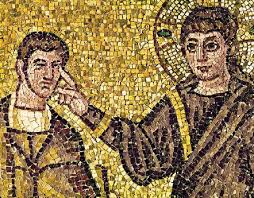
Image result for blind bartimaeus

'Lord Jesus Christ, Son of God; have mercy on me, a sinner'


Seven weeks ago I was in Jericho, leading a party of pilgrims in a retreat in the Holy Land.  We thought of blind Bartimaeus as we drove through the streets of the city – one of the oldest continually inhabited in the world – and saw the sycamore tree which tradition says marks the place where, in Luke’s gospel, Zaccheus had climbed in order to see Jesus.  Bartimaeus and Zaccheus are similar in that they wanted to see: Bartimaeus wanted his sight back and Zaccheus wanted to see Jesus. 

The stories are layered with symbolic meaning and one needs to listen to them with the heart to realise what the writer is saying.  The story of Bartemaeus is recorded by all three synoptic gospels – Matthew, Mark and Luke – but in different ways.  Yet all have this in common: the cure of one who is blind.  But this blindness isn’t just a physical impediment; it is also, at a deeper level, a matter of inner blindness, a theme which we find St. John using.   All the gospel writers, in recounting these stories of the healing of the blind, are inviting us to consider that each of us has an inner eye which needs opening.  As S. Paul wrote in his Letter to Christians in the city of Ephesus:  

I pray that the God of our Lord Jesus Christ, the Father of glory, may give you a spirit of wisdom and revelation as you come to know him, so that, with the eyes of your heart enlightened, you may know what is the hope to which he has called you, what are the riches of his glorious inheritance among the saints, and what is the immeasurable greatness of his power for us who believe, according to the working of his great power. (Eph.1:17-20)

THE HEALING OF OUR INNER BLINDNESS

That – powerful – prayer is one we should take to heart for, as many have realised, each of us is the blind beggar who can cry out to the Lord to have our sight restored.  Have you ever done that?   Have you ever asked Jesus to open the eye of your heart to see the riches of His love for you?  If not, why not?  Just listen to what Jesus says to Bartimaeus when he hears that cry ‘Son of David, have mercy on me!’ (Mk.10:47).  He says: ‘What do you want me to do for you?’

What do you want me to do for you….?

That’s the question that Jesus is saying to each of us. 

And remember Bartimaeus’ answer: Let me see! 

THE JESUS PRAYER


There is another prayer which has been influenced by the cry of Bartimaeus, one known as the ‘Jesus Prayer’, remarkable in its utter simplicity: ‘Lord Jesus Christ, Son of God, have mercy on me, a sinner!’  This prayer, which emerged in the earliest days of Christianity, is also known as the Prayer of the Heart for it is a prayer which is to be repeated over and over again until it descends from the lips to the centre of our being.  It’s a prayer that accompanies our breathing: the phrases ‘Lord Jesus Christ, Son of the Living God’ are uttered as we breathe in and out – ‘have mercy on me, a sinner’.  Those words place us in the right relationship with our Lord and can profoundly move the heart to a deeper expression of faith, hope and love. 

It’s come to be called a prayer of ‘Christian Mindfullness’ but predates by centuries all forms of that practice.  Emerging from early eastern Christianity, it is a prayer which many understand to be the way in which they can fulfil what S. Paul urged us: to unceasing prayer. (I Thess.5:17)   Beginning as a vocal prayer on the lips, and often aided by the use of a Prayer Rope, those who practice it discover that it begins to descend into the heart where – in time – it then lives and so opens the eye of the heart to the Lord.  It is the prayer of Loving Regard; the Prayer of the Compassionate Heart.  The Contemplative Prayer. 

It became known in the West through ‘The Way of the Pilgrim’, a book I first came across in the 1960’s.  As the title suggests, it is the story of an unnamed Russian pilgrim who searched though many years for the answer to that profound question – how can I pray unceasingly?  Eventually he meets a staretz – a holy man – who introduces him to the practice of the Jesus Prayer which he begins to recite constantly and, over time, finds that it changes everything about his life.  Both these prayers, that for the opening of the eye of the heart and the Prayer of the Heart, have as their theme the desire to open the centre of our being to Jesus that we might be changed, transformed – converted – into the person God is making us to be. 

But there’s another aspect of this ‘seeing with the heart’ I want to consider.  For the goal of all our prayer, of the whole of our life, is to be united in the love of God. ‘Sir, we would see Jesus’ (Jn.12:21)

THE DEPARTED

Next week you will be celebrating your Patronal Festival, the Feast of All Saints; the day which commemorates all those who have attained the beatific vision in Heaven.  And then we shall remember all those Souls who have passed from this life and who await that glorious vision.  Traditionally, the month of November is dedicated to the Holy Souls with Masses said for them each day. 

Now we don’t often talk about the departed: most of us have lost loved ones and it can be a painful matter for some to have to consider death.  But, at the heart of our Faith lies this simple desire – that the soul, the essence of who we are, might one day, with all the Saints, be re-united with its Maker in the joy and wonder of heaven.  Traditionally the church has affirmed that before that glorious fulfilment there is a time of preparation.  Yet God’s time is not like ours – as the psalmist said:

To your eyes a thousand years
are like yesterday, come and gone, no more than a watch in the night. (Ps.90:4)

Christianity teaches that, when we die, we will be rewarded in accordance with our faith and our works, for ‘at the end of our days, we shall be judged by our loving.’ It may be that we need time to prepare for the final vision of God – time to be freed from the effects of our sins – and that is why we pray for the departed and offer Masses on their behalf.  Yet because we have free will we have to accept that some may not want to be united in Divine Love – in God – and may choose what we call Hell.  But, for us, heaven is to be at one in love with the Trinity and with Mary and all the Saints.  That is what Jesus opened for us by His Passion and Death and what he longs to share with us. Scripture speaks of this state in images: life, light, peace, wedding feast, wine of the kingdom, the Father's house, the heavenly Jerusalem, paradise: "What no eye has seen, nor ear heard, nor the human heart conceived, what God has prepared for those who love him."  (1 Cor.2:9 cf. Is.64:4)

But these are all images – metaphors – which try to express the inexpressible.  As Peter Abelard wrote in the 12th cent. and which is particularly sung during All Saintstide:

O what their joy and their glory must be,
those endless Sabbaths the blessèd ones see;
crown for the valiant, to weary ones rest:
God shall be All, and in all ever blest.
and his kingdom will have no end.

So, at our death, we may pass immediately to a life with the saints in heaven or spend time in purgatory being prepared for that life.  Or we may find ourselves in Hell, separated from God, if we have not sought to live in love.  Which is why we need to have the eye of our heart opened to see how Jesus is inviting us to respond for God desires no one to spend time in that place. 

Finally, there is the Last Judgment – that moment we affirm when, in the Creed, we proclaim that Christ
will come again in glory
to judge the living and the dead,
The Second Coming of Christ and the final Judgment at the end of Days when, as Matthew records Jesus as saying: the damned ‘will go away into eternal punishment, but the righteous into eternal life.’ (25:46)

CONCLUSION        

Not everyone can see what we have seen nor heard the voice of the Lord nor responded with all their hearts.  Have you left instructions for your own funeral?  It is both a kind thing to do and a means of making sure that you are accorded the proper Rites of the Church.

As we ponder that encounter between Bartimaeus and Jesus may we be strengthened in our desire to see Jesus.  And may the souls of the departed, through the love and mercy of God, be brought to the glories of heaven.  

Monday, May 25, 2015

MORIAR IN SANCTAM CATHOLICAM ET APOSTOLICAM FIDEM DOMINI NOSTRI JESU CHRISTI*

When revising my Will recently I came across this statement of Faith:  

I die in the Holy, Catholic and Apostolic faith of our Lord Jesus Christ (*) as it has been received and taught in the Church of England. I commend my soul to almighty God and trusting in his mercy, implore forgiveness of all my sins. I beg forgiveness of all whom I have injured and I freely forgive those who desire forgiveness of me.

It was developed by the Guild of All Souls as a modern expression of a declaration of faith commonly used in old Wills which endowed chantries.  I found it a moving expression of hope and a final acknowledgement of our need for mercy and so have included it at the end of my Will and commend this practice commend to others.