Showing posts with label Holy Saturday. Show all posts

Friday, April 02, 2021

NOTES CONCERNING GOOD FRIDAY AND HOLY SATURDAY CUSTOMS


TODAY is unlike every other Friday of the year.  It has borne the name ‘Good’ since early in the Christian era because it was on this day that Life triumphed over death, Love over hate, Light over darkness, forgiveness over sin, and God over the forces of evil and the sign of this is the place where it occurred – the Cross.   As full choirs cannot sing at present, here is a recording of Bach’s profound St Matthew Passion

Good Friday customs
Although this day saw the triumph of good, it is also a day of deep sadness that a Man in whom God lived had to die in order to fulfil this victory.  As a mark of sorrow and sense of loss, the Divine Office is abbreviated until Easter Day Matins and the usual notes of joy ar4e omitted.  It begins with the Psalms,  which are said sotto voce, the Glory be is not said and only the Collect offered immediately after the Benedictus.

At the main Liturgy of the Day, during the reading of the Passion, all genuflect at the point when Jesus gave up His spirit and, in a similar way, after the Cross has been venerated and placed in a prominent position, anyone passing genuflects to remind themselves that this is the wood one which Christ died.  There is also a custom that one of the Hosts that had been reserved for Holy Communion is not consumed at this Liturgy but replaced in the ciborium and taken to the 'secret place' (in case it is needed for the dying) where it is kept until being placed back in the tabernacle (or aumbry) after Mass on Easter Day.  Some churches have a small tabernacle in the Sacristy for this purpose where it can be securely kept until Easter Day.

In the early evening the Cross is taken from the altar and ‘buried’ so that the body of Jesus doesn’t remain on view but is taken from the cross and laid in the tomb, thus completing the Liturgy of Good Friday.  A small table, surrounded by flowers and candles, should be placed in the chancel and, during the Liturgy, the Cross is taken from the altar and placed beneath the Epitaphios (burial shroud) on the table, symbolising the Tomb of Christ, thus completing the biblical account of this day.  Here is a short Liturgy of the Deposition that can be used for this observance.

Holy Saturday customs

Today priests devotionally wash and anoint church altars with oil, symbolising the way the dead are normally treated before burial.  Whilst Jesus’ body wasn’t treated in this way, it is a custom that helps us connect with the desires of Mary Magdalene who came to Jesus’ tomb early in the morning of Easter Day.  This can be extended to washing the statues as a further devotional act offered to the saints.  And whilst this is the 'day of preparation', it is also the day when Christ entered into deeper darkness to draw our primordial, metaphorical parents - Adam and Eve - from death to life and so the crucified is left lying in the darkness until Easter Day, and so the Crucified is left lying in the darkness until Easter Day.

Friday, May 01, 2020

PRIESTLY PONDERING'S (2) - Prayer, the heartbeat of life


(These 'Ponderings' are available via YouTube:  https://youtu.be/leecLTTnHu4)

‘I said to my soul, be still, and let the darkness come upon you
Which shall be the darkness of God.’ (East Coker, III)

In the first of these ‘Ponderings’ I quoted those lines by T. S. Eliot in connection with the way this pandemic is forcing many of us into a place of loss.  That’s been made worse, for some clergy, by the absence of ‘real time’ pastoral contact compounded by that instruction from the hierarchy about not entering churches. This seminal crisis is causing some to experience an existential darkness seeping through their vocation; the very things priests were identified as possessing and ordained to express – an ability to care, an empathic nature, praying the Divine Office in church – all that and more, has been denied.  And, despite valiant efforts to nurture their calling, some are feeling let down, lost and fearful. 

In that first ‘Pondering’ I said that this period reminds me of the way Christ entered the darkness on Holy Saturday with the light of the Resurrection. I touched on this in my second book, ‘The Mystery of Faith’ when, in Chapter 6, I wrote about Christ’s descent into this darkness, a darkness he allowed to overwhelm him but which, in the end, didn’t overcome him;

‘There’s something of deep significance in Christ’s journey into the realm of Death, for the effect of his redemption works at both a conscious and unconscious level, affecting the whole cosmic order. Carl Jung said it also represents the ego’s deliberate descent into the unconscious where it emerges reborn.

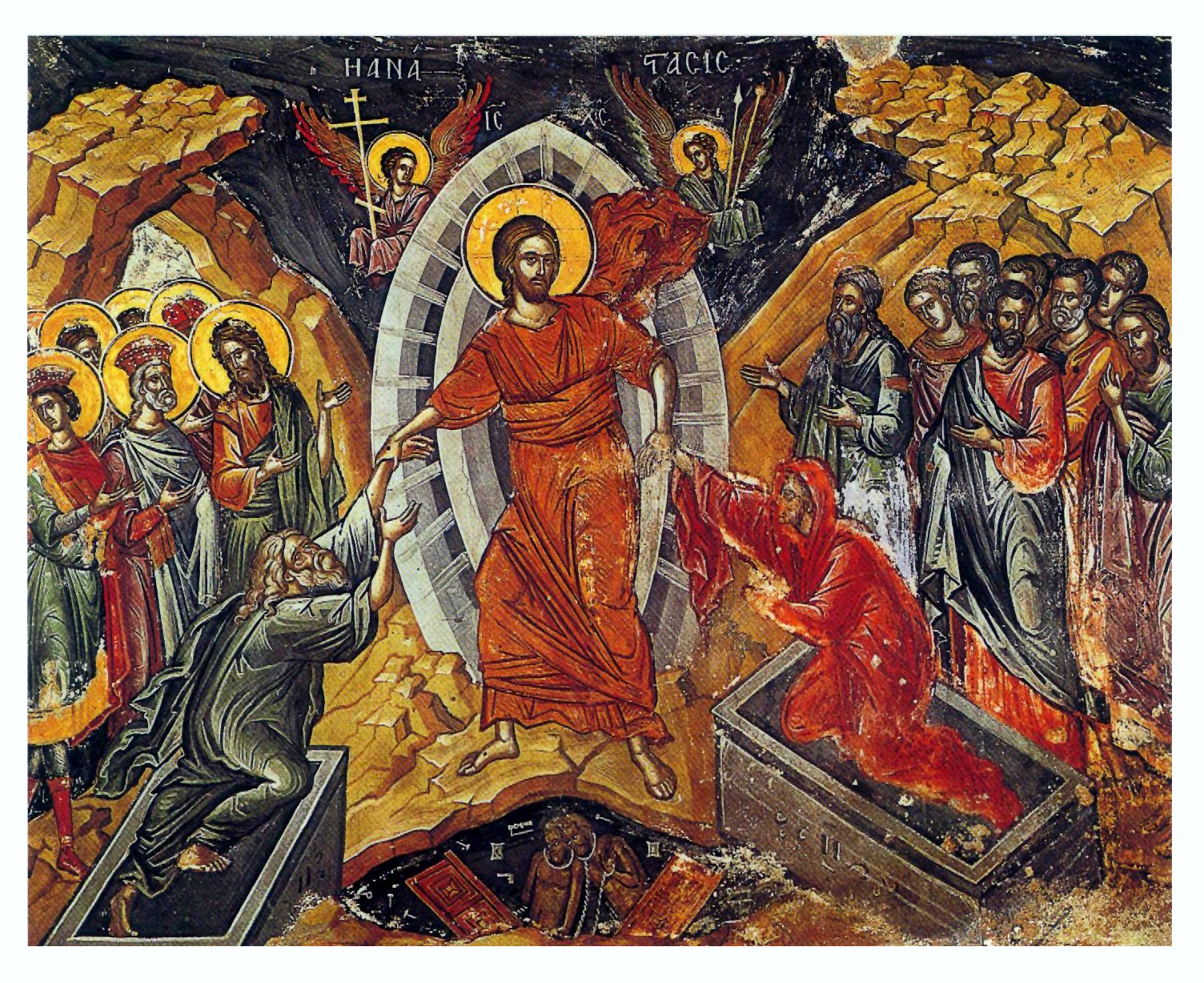
This great event, celebrated in the – neglected – Liturgy of the Burial of Christ, is portrayed in orthodox icons by the image of his descent into that darkness.  He breaks into the prison-house of death and drags Adam and Eve, our archetypal ancestors, from sleep into the light of his Divinity.  This, arguably, is the great moment of salvation – his victory which redeems all humankind, even back to the beginning.  And our ceaseless task is to open ourselves more and more deeply to Christ’s gracious, compassionate invitation to be set free.’  (p.61f)

As both theology and psychology agree in the importance of this event, it’s clearly of primary importance.  God needs to descend into our depths and illuminate them with resurrection light, something the icon of the Anastasis reveals.  It also reveals just how hard it was for our archetypal parents, Adam and Eve, to receive that light into which Christ had to drag them.  It’s in that darkness we encounter our vulnerability, the place where we realise the need for humility, where we open ourselves to the reality of our human frailty.  It’s a darkness which we proclaim Christ entered; he has broken open that place by the light of the resurrection, and where Christ has gone, we need to follow despite any fear we may have; for our gospel is that the darkness cannot overcome us.  Isn’t that what we should be proclaiming and every parish celebrating? 

This year the Paschal Triumph has an importance that we need to take to heart.  We may not be able to be with people in their sickness, their suffering or their dying, but we can seek to be in that place of dazzling darkness.  Christ invites priests, in particular, to be open to that for, as part of the Holy People of God, we need to lead where all must go.  Isn’t our vocation to show the way, no matter how hard, how very hard, it can be?  Whatever Christ meant when John records him as saying in the gospel for Good Shepherd Sunday: “I came that they may have life, and have it abundantly”, it’s clear the life he offers comes as a consequence of passing through suffering and death.  People won’t hear about that on the TV News – they’ll only hear it if we tell them what we’re discovering.

Death and life are, of course, the twin foundations of our faith – and the former isn’t pleasant!  For a priest, at this time, it can be experienced in a variety of ways.  Yet, through it all, there is one thing that matters, and that’s our faithfulness to our calling.  Not to what we do, for we are denied much of that, but to the call of Christ ‘who was faithful to the one who appointed him, just as Moses also was faithful’ (Heb.3.2).  As I said in Enfolded, Christ didn’t save us by his ability but through his disability (p.109). Our faithfulness is, primarily, to the God who calls us and that must mean faithfulness to be open to that call – to prayer.  About that, one enclosed sister wrote to me:

‘I think as a monastic I am aware how beneficial the rhythm and routine of the life we live is.  ... Unfortunately, it is much easier to form a rhythm when things are normal, so that it is there to fall back on when they aren't’.

So, maybe this is the time to look at your Rule of Life and check what norm you have created in relation to praying, and not simply saying, the Divine Office each day.  Occasions when we enter the wonder of Christ’s prayer to the Father through the Spirit not just twice, but maybe four or more times a day.  But any prayer – especially meditation – can become boring, especially when it doesn't seem there's any consolation in it. But Christian meditation – or contemplation – isn’t passive ‘quietism’ but desiring to be where Christ is; and whether that’s in the joy of heaven or the darkness of hell, we’re called to be there.  Whatever we experience (and it’s not the experience we’re to desire, but God) we’re called to be faithful to the way that leads to divine union.  As sister pointed out:

“Learning to inhabit boredom when it is around is important; not easy, but we get into patterns of distracting ourselves when things are not very exciting.  If we can sit with boredom and restlessness when they are there and realise that they are normal – we don't need to feel a failure or guilty, just sit with the discomfort.  We are being pushed to realise that our value is in being and not doing – doing flows from being – and it is uncomfortable for people.  On the whole we take our identity and value from what we can do, and for lots of people having the usual opportunities for doing taken away is very uncomfortable!  We don't really know how to be alone and unoccupied.  We will face an apparent void we think, nothing there, if we are not 'doing'.”

That clearly speaks of the way our life is united with Christ’s oblation ‘of himself once offered’ – and an oblation isn’t a pleasant thing!  It’s bloody and involves the apparent loss of everything that makes life meaningful but, as I said in Enfolded, ‘We follow one who was a failure in the sight of most of his contemporaries, yet who could never have been a failure in the sight of his Father.  Jesus wasn't formed for success but for faithfulness’ (p.57).  It’s the way of the saints: of Theresa of Lisieux who wrote in ‘Autobiography of a Soul’:

‘He allowed my own soul to be plunged into the thickest gloom. The thought of heaven which had been so sweet from my earliest years became for me a subject of torture.  The trial did not merely last for days or weeks.  As I write, it has gone on for months and still I am waiting for relief.  I wish I could explain what I feel, but it is beyond my power.  One must have passed through the tunnel to understand how black its darkness is.’

She had wanted to be a priest and now God allowed her a share in Christ’s passion whereby she had to live by faith – and love – alone.  It’s the way of St John of the Cross who, thrown into a dungeon by his Carmelite confreres because they didn’t approve his reforms, produced from that place of deprivation some of the greatest poetry ever written.  Who said:

“Never give up prayer, and should you find dryness and difficulty, persevere in it for this very reason. God often desires to see what love your soul has, and love is not tried by ease and satisfaction.” – St. John of the Cross, Special Counsels: Degrees of Perfection #9

Perhaps this pandemic is forcing us to face what lies beneath the surface of our lives, inviting us to consider where we look for our primal meaning.  Without so many of the norms of ministry we might experience a sense of being overwhelmed by darkness.  One of the reasons why it’s important to continue to offer Christ’s oblation is that it’s concerned with overcoming the darkness of death – it unlocks the gates of Hades and, with great tenderness, sets prisoners free.  Unfortunately – and misleadingly – some say of that day that it’s when Christ ‘rested’, a day of “dead silence” (Pastoral Letter, Archbishops of Canterbury and York, 2018) when nothing happened.  But, lying at the heart of the Paschal Mystery, it’s the greatest day of salvation, the day when what is most important occurs. 


Feelings of loss and confusion can drive us away from our calling, yet it’s precisely at this moment we need to be present to prayer.  Present to the Spirit moving within us as we open our heart – with all its messy emotions – to God whose ongoing work of salvation will be occurring at the deepest levels.  Prayer which isn’t just the words we utter but what happens in a heart inclined to God; which goes on gently even when we’re unconscious of it.  We have to set up the rhythm – like the rhythm of breathing – because prayer is the heartbeat of life. 

It may be that this pandemic is forcing us into places we would never enter by our own efforts.  Now, like the contemplative, God invites us to enter the worlds lostness with the flickering light of Christ.  Not our flame but his, carried in our heart.  We may fail at times, fall flat on our faces or even run from this calling, but it’s fundamental to the nature of priesthood.  All we need to do is be there, in the darkness and despair with the light of Christ’s love.  He does the work.  

John-Francis Friendship
April 30th 2020

Monday, April 06, 2020

HOLY SATURDAY 2020 - Sermon for All Saints, Blackheath


“Let him Easter in us,
be a dayspring to the dimness of us.”

X

INTRODUCTION
So wrote Gerard Manly Hopkins in his epic poem, The Wreck of the Deutschland, a ship that, in 1875, floundered off the coast of Harwich and in which five Franciscan nuns, fleeing persecution in Germany, were drowned.   ‘Let him Easter in us’

It is such an odd use of the word; surely ‘Easter’ is an event, not an experience; a noun not a verb?  Yet, here is Hopkins inviting us to let Christ ‘Easter in us’.   But it’s a great way to look at the truth, the transforming reality of Easter.  For Easter is about an activity that does not apply to something we do but something ‘he’ does in us.  Let Easter get into us.  Let Easter come and live where we live.  Let Easter permeate our souls.  Let him Easter in us; be as a new day to the darkness in us.  

Tonight we normally gather, after the long rigours of Lent and Holy Week, to do just that.  To let Christ ‘Easter’ in us.  Not to wistfully recall a long-ago episode, affirm our faith or even to worship at a powerful and moving Liturgy.  But to be present before the One who can Easter in our lives; we gather because we want to be transformed, given new life, find meaning and purpose.  Isn’t that what each of us longs for?  What we really want?  To know Easter in us.

Poetry, of course, takes us to places that prose cannot.  It is a way of painting with words and, like any painting it looses something when you try to explain its meaning.  Its power lies in the way the words effect the soul.  It’s the difference between the women described in tonight’s gospel reading from Matthew (28.1f) as running from the tomb with great fear and joy, and the description of Mary Magdalene, in the gospel for Easter Day (John 20.11), standing alone and encountering the risen Christ who forbade her to touch him: she needed to take that encounter to heart, not to make sense of it.

St. Paul in his Letter to the Romans hints at something similar: ‘For if we have been united with him in a death like his, we will certainly be united with him in a resurrection like his’ (6:5).  Hopkins, on the other hand, reflects that same faith in fewer words: ‘Let Him … be a dayspring to the dimness in us.’

So here we are, like Mary Magdalene, before the mystery at the heart of our Faith, a Faith that is not focussed on the way we should live, or on the quality of life; not on creating a particular social order or helping people deal with pain and sickness, though it involves all of that and more.  Rather, ours is a faith that is centred on the death and resurrection of Christ.  It asks you and I to stand before that one event (for the two are one, though separated in time) and gaze upon it with loving eyes in the belief that that which you desire, that upon which you set your heart, will change you.  ‘Let him Easter in us.’

BAPTISED INTO LIFE IN CHRIST
This year we’re unable to celebrate this mystery with symbols that speak to us about life: fire and light; bread and wine.   We can’t encounter these sacramentals, as Mary Magdalene encountered Christ, material things which don’t speak into our understanding, but into our heart.  Although there is one symbol we can use – water.   If you can, go now and fill a glass bowl with water … 

We use water to wash and cleanse, to drink and enjoy.  But water also ends life, as it ended the lives of those Franciscans – and it can restore to life.  It is the ocean of birth and the river of death.  Hopkins was moved by the drowning of those five sisters, but he understood their death to be the fulfilment of baptism into new life, their rebirth into Christ, so concludes his poem:

Now burn, new born to the world,
                                                Doubled-naturèd name,
                        The heaven-flung, heart-fleshed, maiden-furled
                                     Miracle-in-Mary-of-flame,
Mid-numbered He in three of the thunder-throne!

Hopkins saw in this wrecked ship the lot of a world gone astray.  He compares it with the ark of salvation, the barque in which we’re saved.  He saw in the water the womb of Mary and the birth of Christ, and beneath the waters of death saw the ground of our being – what he called the ‘granite of God’.   Tonight, we can affirm our own faith in the granite – the Christ-rock: just dip your fingers into the water and make the sign of the cross over yourself …

None of us are immune to the ravages of existence; all of us are at risk of infection.  Sometimes it can feel as if we, too, are drowning beneath the terror of it all.  There will be moments, maybe days or weeks, when we seem to be existing beneath a dark pall, when it seems as if the storms of life will never pass.  That is when we need to hold fast in Christ. 

Eventually the storm will pass and calm will come; it’s then we need to make sure that that which holds and carries us, the faith which we profess, the hope which we have and the love which holds us in his hands, lies at the heart of our attention.  And there will be moments when we just need to bask in the sun of God: ‘Let Him Easter in us, be a dayspring to the dimness in us.’

CONCLUSION
So, let’s live as Easter people!  Live the faith we profess tonight: Christ is risen. For “… if we have been united with him in a death like his, we will certainly be united with him in a resurrection like his.” (Roms. 8:5)

This is the night when first you saved our fathers:
you freed the people of Israel from their slavery
and led them dry-shod through the sea.
This is the night when Christians everywhere,
washed clean of sin and freed from all defilement,
are restored to grace and grow together in holiness.
This is the night when Jesus Christ broke the chains of death
and rose triumphant from the grave.

Christ is risen, and hell is cast down!
Christ is risen, and the demons are fallen!
Christ is risen, and the angels rejoice!
Christ is risen, and life reigns in freedom!
Christ is risen, and the grave is emptied of the dead!

Let him Easter in us as we gaze upon him, not seeking to hold him but, rather, to be held in him who is our life and who offers us Easter.

Alleluia!!

Saturday, March 31, 2018

AN ANCIENT SERMON FOR HOLY SATURDAY


Today there is a great silence over the earth, a great silence, and stillness, a great silence because the King sleeps; the earth was in terror and was still, because God slept in the flesh and raised up those who were sleeping from the ages. God has died in the flesh, and the underworld has trembled.
            Truly he goes to seek out our first parent like a lost sheep; he wishes to visit those who sit in darkness and in the shadow of death. He goes to free the prisoner Adam and his fellow-prisoner Eve from their pains, he who is God, and Adam's son. 
            The Lord goes in to them holding his victorious weapon, his cross. When Adam, the first created man, sees him, he strikes his breast in terror and calls out to all: 'My Lord be with you all.' And Christ in reply says to Adam: ‘And with your spirit.’ And grasping his hand he raises him up, saying: ‘Awake, O sleeper, and arise from the dead, and Christ shall give you light.
            ‘I am your God, who for your sake became your son, who for you and your descendants now speak and command with authority those in prison: Come forth, and those in darkness: Have light, and those who sleep: Rise. 
           'I command you: Awake, sleeper, I have not made you to be held a prisoner in the underworld. Arise from the dead; I am the life of the dead. Arise, O man, work of my hands, arise, you who were fashioned in my image. Rise, let us go hence; for you in me and I in you, together we are one undivided person.
           'For you, I your God became your son; for you, I the Master took on your form; that of slave; for you, I who am above the heavens came on earth and under the earth; for you, man, I became as a man without help, free among the dead; for you, who left a garden, I was handed over to Jews from a garden and crucified in a garden.
            'Look at the spittle on my face, which I received because of you, in order to restore you to that first divine in-breathing at creation. See the blows on my cheeks, which I accepted in order to refashion your distorted form to my own image. 
            'See the scourging of my back, which I accepted in order to disperse the load of your sins which was laid upon your back. See my hands nailed to the tree for a good purpose, for you, who stretched out your hand to the tree for an evil one.
            'I slept on the cross and a sword pierced my side, for you, who slept in paradise and brought forth Eve from your side. My side healed the pain of your side; my sleep will release you from your sleep in Hades; my sword has checked the sword which was turned against you.
           ' But arise, let us go hence. The enemy brought you out of the land of paradise; I will reinstate you, no longer in paradise, but on the throne of heaven. I denied you the tree of life, which was a figure, but now I myself am united to you, I who am life. I posted the cherubim to guard you as they would slaves; now I make the cherubim worship you as they would Go
            'The cherubim throne has been prepared, the bearers are ready and waiting, the bridal chamber is in order, the food is provided, the everlasting houses and rooms are in readiness; the treasures of good things have been opened; the kingdom of heaven has been prepared before the ages."
 ______________________________________________________

Prayer

Almighty, ever-living God
whose Only-begotten Son descended to the realm of the dead, 
and rose from there to glory, grant that your faithful people, 
who were buried with him in baptism,
may, by his resurrection, obtain eternal life.  
Through Christ our Lord.  Amen


Sunday, March 25, 2018

HOLY SATURDAY – Christ descends into our depths to draw us into Life.


From time to time I notice comments concerning Holy Saturday which refer to it as a “day of rest” or one of “waiting and watching” – an “empty liturgical day” or as the Archbishops of Canterbury and York said in a Pastoral Letter in 2018, a day of “dead science”.  This may be the understanding of the western churches but it is not the Orthodox understanding of this day as is made clear in this Homily by St. Ephrem the Syrian (c.306-373), quoted in the Office of Readings:

‘Death had its own way when our Lord went out from Jerusalem carrying his cross; but when by a loud cry from that cross he summoned the dead from the underworld, death was powerless to prevent it. Death slew him by means of the body which he had assumed, but that same body proved to be the weapon with which he conquered death. Concealed beneath the cloak of his manhood, his godhead engaged death in combat … It was able to kill natural human life, but was itself killed by the life that is above the nature of man…. He came in search of a chariot in which to ride to the underworld. This chariot was the body which he received from the Virgin; in it he invaded death’s fortress, broke open its strong room and scattered all its treasure.’

This theology/spirituality of the anastasis or ‘harrowing of hell’ emerges from a number of scriptural references.  For example, in 1 Peter 3: 18b: ‘He was put to death in the flesh, but made alive in the Spirit, in which also he went and made a proclamation to the spirits in prison’ and 4:6 that ‘… the gospel was proclaimed even to the dead, so that though they had been judged in the flesh as everyone is judged, they might live in the spirit as God does’.  This doctrine seems, in part, a response to the statement in Job: ‘As waters fail from a lake, and a river wastes away and dries up, so mortals lie down and do not rise again; until the heavens are no more, they will not awake or be roused out of their sleep. O that you would hide me in Sheol, that you would conceal me until your wrath is past, that you would appoint me a set time, and remember me!  If mortals die, will they live again? All the days of my service I would wait until my release should come.’ (14: 11-14) 

There is a rich liturgical observance of this work of Christ amongst the dead found in The Festal Menaion, translated into English by Mother Mary and Bishop Kalistos Ware.  It has always seemed sad to me that, liturgically, we leave Christ on the Cross on Good Friday so some years ago I used aspects of Orthodox Vespers of that day and the Liturgy for Great and Holy Saturday to create a short Night Office of the Deposition and Burial of Christ.  It includes aspects of Tenebrae and concludes with the Blessing of Graves and can be celebrated on the evening of Good Friday thus offering a service for those who may not be able to attend the afternoon Liturgy of the Day (Anglicans seem to have ignored the fact that some people are unable to attend services during the day!). 

The Descent of the Ego and Union with God
But there is more, it seems to me, than simply re-enacting the physical events of this movement from Cross to grave.  Something of deep significance in Christ’s journey into the realm of Death and Hades.  For the effect of His redemption works at both a conscious and unconscious level, affecting the whole cosmic order.   As one write has observed: ‘As a phase of individuation, Edinger* points to the descent as having “the greatest importance to depth psychology” in that it represents “the ego’s deliberate descent into the unconscious.”  The light of the ego is temporarily extinguished in the upper world and is carried into the lower world where it rescues worthy contents of the unconscious and even conquers Death itself.

‘The imagery of the descent into hell is analogous to the ego’s fall into the unconscious for a prolonged time and to a depth from which it emerges as one reborn, and as a result now seeks to serve the Self who serves the All.  Jung views this prolonged encounter as the psychological equivalent of the integration of the collective unconscious and as forming “an essential part of the individuation process.”(Jung, ‘Aion’, CW9ii, par 72). 

Similarly, St John of the Cross speaks of “the cleansing fire of the dark night.” when, Divine light . . . acts upon the soul which is purged and prepared for perfect union in the same way as fire acts upon a log of wood in order to transform it into itself.’ (Soul Afire, op cit. 258-259)’

Far from Holy and Great Saturday, lying as it does at the heart of the Paschal mystery, being a day when ‘nothing happens’ it is, arguably, the great day of salvation.  For whilst western artists have portrayed the glory of resurrection as the appearance of Christ to humankind, orthodox iconography knows nothing of this but, rather, presents us with the image of Christ drawing Adam and Eve, our archetypal ancestors, from their slumbers into the Mandorla of His divinity.  This action symbolizes that his victory redeems all humankind, even back to the beginning.  This resurrection scene is taking place in the past, present, and future.  And our ceaseless task is to open ourselves more and more deeply to Christ’s gracious, compassionate invitation into life.

“When in the new tomb you, the Redeemer of all, had been laid for the sake of all, hell became a laughing stock and, seeing you, quaked with fear; the bars were smashed, the gates were shattered, the graves were opened, the dead arose ...When you went down to death, O immortal Life, you slew hell with the lightning flash of your Godhead”
(from
: The Good Friday Matins of Great Saturday)
____________________________________________

(*Edinger, op cit, ‘Christian Archetype’, p 110) 

Wednesday, March 29, 2017

HOMILY PREACHED ON THE OCCASION OF THE TRIGGERING OF ARTICLE 50 (BREXIT)

at the Midday Eucharist
March 29th, 2017
SOUTHWARK CATHEDRAL
_________________________


+ In the name of God, the All-Compassionate, the All-Merciful.  Amen.

Today is a momentous day in the life of our nation and it would be wrong to ignore what is happening, possibly even as we celebrate this Eucharist.  For our Prime Minister is to send a letter to the European Commission to announce that we wish to withdraw from the Union.

It is a day when we are divorcing from a relationship that has lasted 44 years.  For some this is the ending of a marriage made in heaven; for others it is the opposite.  Some will lament the death of a dream – of the hope for a more united world.  Others see this as the dawn of a new age when we take back control of our laws and borders.  And there are those who see this as a second Reformation – in the first we separated from Rome; in this from Brussels.  It certainly heralds a paradigm shift:

‘As, in a theatre,
The lights are extinguished, for the scene to be changed
With a hollow rumble of wings, with a movement of darkness on darkness,
And we know that the hills and the trees, the distant panorama
And the bold imposing facade are all being rolled away—‘

So wrote T.S.Eliot in his poem, ‘East Coker’.  And he prefixed those words by saying: ‘I said to my soul, be still, and let the dark come upon you Which shall be the darkness of God.’ 

Whatever the outcome of this movement we hold to Christ who is our hope.  Whose life-giving Passion, Death and Resurrection we proclaim as we celebrate this Eucharist.  Of Him in whom there is neither Jew nor Greek, slave nor free.  For we are all one in Him. 

Perhaps, in a way, we are entering upon our own Holy Saturday, that time of waiting as the old order passes away, yet we know not the new which is to come. 

Later on in ‘East Coker’ Eliot wrote these words which emerged from his own Christian faith: “I said to my soul, be still and wait without hope, for hope would be hope for the wrong thing; wait without love, for love would be love of the wrong thing; there is yet faith, but the faith and the love are all in the waiting. Wait without thought, for you are not ready for thought: So the darkness shall be the light, and the stillness the dancing.”    

Amen.


Saturday, March 26, 2016

READING FROM AN ANCIENT HOMILY FOR HOLY SATURDAY


‘WHAT is happening? Today there is a great silence over the earth, a great silence, and stillness, a great silence because the King sleeps; the earth was in terror and was still, because God slept in the flesh and raised up those who were sleeping from the ages. God has died in the flesh, and the underworld has trembled.

Truly he goes to seek out our first parent like a lost sheep; he wishes to visit those who sit in darkness and in the shadow of death. He goes to free the prisoner Adam and his fellow-prisoner Eve from their pains, he who is God, and Adam's son.

The Lord goes in to them holding his victorious weapon, his cross. When Adam, the first created man, sees him, he strikes his breast in terror and calls out to all: 'My Lord be with you all.' And Christ in reply says to Adam: ‘And with your spirit.’ And grasping his hand he raises him up, saying: ‘Awake, O sleeper, and arise from the dead, and Christ shall give you light.

‘I am your God, who for your sake became your son, who for you and your descendants now speak and command with authority those in prison: Come forth, and those in darkness: Have light, and those who sleep: Rise.

‘I command you: Awake, sleeper, I have not made you to be held a prisoner in the underworld. Arise from the dead; I am the life of the dead. Arise, O man, work of my hands, arise, you who were fashioned in my image. Rise, let us go hence; for you in me and I in you, together we are one undivided person.

‘For you, I your God became your son; for you, I the Master took on your form; that of slave; for you, I who am above the heavens came on earth and under the earth; for you, man, I became as a man without help, free among the dead; for you, who left a garden, I was handed over to Jews from a garden and crucified in a garden.

‘Look at the spittle on my face, which I received because of you, in order to restore you to that first divine in-breathing at creation. See the blows on my cheeks, which I accepted in order to refashion your distorted form to my own image.

'See the scourging of my back, which I accepted in order to disperse the load of your sins which was laid upon your back. See my hands nailed to the tree for a good purpose, for you, who stretched out your hand to the tree for an evil one.

`I slept on the cross and a sword pierced my side, for you, who slept in paradise and brought forth Eve from your side. My side healed the pain of your side; my sleep will release you from your sleep in Hades; my sword has checked the sword which was turned against you.

‘But arise, let us go hence. The enemy brought you out of the land of paradise; I will reinstate you, no longer in paradise, but on the throne of heaven. I denied you the tree of life, which was a figure, but now I myself am united to you, I who am life. I posted the cherubim to guard you as they would slaves; now I make the cherubim worship you as they would God.


"The cherubim throne has been prepared, the bearers are ready and waiting, the bridal chamber is in order, the food is provided, the everlasting houses and rooms are in readiness; the treasures of good things have been opened; the kingdom of heaven has been prepared before the ages.’

Saturday, April 04, 2015

HOLY SATURDAY - God descends into our depths to draw us into Life


From time to time I notice comments concerning this day, Holy Saturday, which refer to it as a “day of rest” or one of “waiting and watching” – an “empty liturgical day”.  This may be the understanding of the western churches but it is not the Orthodox understanding of this day as is made clear in this Homily by St. Ephrem the Syrian (c.306-373), quoted in the Office of Readings for the Friday in Easter Week:

Death trampled our Lord underfoot, but he in his turn treated death as a highroad for his own feet. He submitted to it, enduring it willingly, because by this means he would be able to destroy death in spite of itself. Death had its own way when our Lord went out from Jerusalem carrying his cross; but when by a loud cry from that cross he summoned the dead from the underworld, death was powerless to prevent it.

Death slew him by means of the body which he had assumed, but that same body proved to be the weapon with which he conquered death. Concealed beneath the cloak of his manhood, his godhead engaged death in combat; but in slaying our Lord, death itself was slain. It was able to kill natural human life, but was itself killed by the life that is above the nature of man.

Death could not devour our Lord unless he possessed a body, neither could hell swallow him up unless he bore our flesh; and so he came in search of a chariot in which to ride to the underworld. This chariot was the body which he received from the Virgin; in it he invaded death’s fortress, broke open its strongroom and scattered all its treasure.

At length he came upon Eve, the mother of all the living. She was that vineyard whose enclosure her own hands had enabled death to violate, so that she could taste its fruit; thus the mother of all the living became the source of death for every living creature. But in her stead Mary grew up, a new vine in place of the old. Christ, the new life, dwelt within her. When death, with its customary impudence, came foraging for her mortal fruit, it encountered its own destruction in the hidden life that fruit contained. All unsuspecting, it swallowed him up, and in so doing released life itself and set free a multitude of men. …

We give glory to you, Lord, who raised up your cross to span the jaws of death like a bridge by which souls might pass from the region of the dead to the land of the living. We give glory to you who put on the body of a single mortal man and made it the source of life for every other mortal man. You are incontestably alive. Your murderers sowed your living body in the earth as farmers sow grain, but it sprang up and yielded an abundant harvest of men raised from the dead. …

This theology/spirituality of the anastasis or ‘harrowing of hell’ emerges from a number of scriptural references, not all of them apocryphal.  For example, in 1 Peter 3: 18b: ‘He was put to death in the flesh, but made alive in the Spirit, in which also he went and made a proclamation to the spirits in prison’ and 4:6 that ‘… the gospel was proclaimed even to the dead, so that though they had been judged in the flesh as everyone is judged, they might live in the spirit as God does’.  This doctrine seems, in part, a response to the statement in Job: ‘As waters fail from a lake, and a river wastes away and dries up, so mortals lie down and do not rise again; until the heavens are no more, they will not awake or be roused out of their sleep. O that you would hide me in Sheol, that you would conceal me until your wrath is past, that you would appoint me a set time, and remember me!  If mortals die, will they live again? All the days of my service I would wait until my release should come.’ (14: 11-14) 

There is a rich liturgical observance of this work of Christ amongst the dead found in The Festal Menaion, translated into English by Mother Mary and Archimandrite (now Bishop) Kalistos Ware.  It has always seemed sad to me that, liturgically, we leave Christ on the Cross after the Liturgy of Good Friday  and so some years ago I used aspects of Orthodox Vespers of Good Friday and the Liturgy for Great and Holy Saturday to create a short Night Office of the Deposition and Burial of Christ which includes aspects of Tenebrae and concludes with the Blessing of Graves which can be celebrated on the evening of Good Friday.  It also offers a service for those who may not be able to attend the afternoon Liturgy of the Day (Anglicans seem to have ignored the fact that some people are unable to attend services during the day!). 

But there is more, it seems to me, than simply re-enacting the physical events of this movement from Cross to grave.  Something of deep significance in Christ’s journey into the realm of Death and Hades.  For the effect of His redemption works at both a conscious and unconscious level, affecting the whole cosmic order.   As one write has observed:

‘As a phase of individuation, Edinger* points to the descent as having “the greatest importance to depth psychology” in that it represents “the ego’s deliberate descent into the unconscious.” The light of the ego is temporarily extinguished in the upper world and is carried into the lower world where it rescues worthy contents of the unconscious and even conquers Death itself. (*Edinger, op cit, ‘Christian Archetype’, p 110)  The imagery of the descent into hell is analogous to the ego’s fall into the unconscious for a prolonged time and to a depth from which it emerges as one reborn, and as a result now seeks to serve the Self who serves the All.  Jung views this prolonged encounter as the psychological equivalent of the integration of the collective unconscious and as forming “an essential part of the individuation process.”(Jung, ‘Aion’, CW9ii, par 72).  Similarly, St John of the Cross speaks of “the cleansing fire of the dark night.” when, Divine light . . . acts upon the soul which is purged and prepared for perfect union in the same way as fire acts upon a log of wood in order to transform it into itself. (Soul Afire, op cit. 258-259)’  © ‘Higher Ground’ by Ann K. Elliott

Far from Holy and Great Saturday, lying as it does at the heart of the paschal mystery, being a day when ‘nothing happens’ it is, arguably, the great day of salvation.  For whilst western artists have portrayed the glory of resurrection as the appearance of Christ to humankind, orthodox iconography presents us with the image of Christ drawing Adam and Eve, our archetypal ancestors, from their slumbers into the Mandorla of His divinity.  This action symbolizes that his victory redeems all humankind, even back to the beginning.  The dynamic of resurrection is taking place in the past, present, and future.  (http://www.orthodoxroad.com/christs-descent-into-hell-icon-explanation/)  And our ceaseless task is to open ourselves more and more deeply to Christ’s gracious, compassionate invitation into life.

“When in the new tomb you, the Redeemer of all, had been laid for the sake of all, hell became a laughing stock and, seeing you, quaked with fear; the bars were smashed, the gates were shattered, the graves were opened, the dead arose ...When you went down to death, O immortal Life, you slew hell with the lightning flash of your Godhead” (from: The Good Friday Matins of Great Saturday)