Showing posts with label Advent. Show all posts

Sunday, December 20, 2020

SERMON for ADVENT 4 - December 20th, 2020

2 Sam. 7: 11-11,16    Nathan tells David that God is not concerned with a house for himself; he will make of David a great nation.
Roms. 16: 25-27    Glory to God who reveals himself.
Luke 1: 47-55   Annunciation

______________________________________________________

O Key of David, and sceptre of the House of Israel;
that opens and no one shuts, and shuts, and no one opens;
come and bring the prisoner out of the prison-house,
the one who sits in darkness and the shadow of death.

I wonder what you’re looking forward to this Christmas …  That might seem a somewhat insensitive thing to ask because, for many, it seems that Christmas has been ruined and, for some, this pandemic has been ruinous.  But, in a way, that’s what makes the question ‘what are you looking forward to’ even more important. 

The words I used to begin this sermon were taken from today’s Antiphon sung before and after the Magnificat at Evening Prayer.  They’re part of what are called the seven ‘Great ‘O’’s, affirmations of hope and faith taken from the Old Testament concerning times when Israel – the people of Israel – were experiencing terrible suffering, and we can use them to express our own hopes and longings at this time.  And whilst all of them emerged at times of profound need none are simply expressions of any superficial hope – they touch into some of the most profound desires human beings have: we desire Wisdom, an enlightened Leader, a Sign, Key, Enlightener, King – and the final desire provides the focus for the most important of all, which has become a popular Advent hymn, ‘O come, O come, Emmanuel’.   So, again, I wonder what you long for this Christmas?  For Christians it has to be ‘for Christ’.  For Christ to come with the gift of Wisdom; for Christ my Leader whom I desire to recognise by the Signs he offers; for Christ who can enlighten everyone us and whom all nations will acclaim as their King.

Today’s antiphon uses the symbol of Christ as the ‘key’ for which we long, the key which will unlock the ‘prison-house’ in which we dwell.  That metaphor has particular relevance at a time when many must feel as if they are imprisoned in their homes, and our longing must be that they will turn to Christ who is the key to their freedom.  No, he won’t let them roam freely and risk the health of themselves or others!   We long for the key that will release us from our fears, the key that will give me the freedom I need which will give me more than can comes from watching endless, mindless game shows or entertainment programmes on TV; more life than can be found via the internet.  So, today, we cry – ‘release me from my prison!’ 

ANNUNCIATION
Today’s gospel reading also reminds us of another longing – Mary’s longing to do God’s will.  We’re reminded of the confusion that can accompany our longings and the trust and faith we need to have when we express those longings to God. 

You may have noticed that in the long opening chapter to St. Luke’s gospel he records not just one but two annunciations.  The familiar one we’ve just heard and, a few verses beforehand, an angelic annunciation to a man, Zachariah, concerning the birth of another boy, your heavenly Patron, St. John the Forerunner.  But there’s a great difference between the two, for Zachariah heard the angel, doubted the message and was struck dumb whereas Mary questioned the angel – she didn’t doubt what she heard but wanted clarification: ‘how can this be?’

It’s clear that Mary had long desired to do God’s will – isn’t that what we all desire?  But she could never have anticipated what that might involve.  Becoming the God-bearer!  How can that be?  I’m too young, old, the wrong gender, nationality, social class and so on.  But her response, in the end, is another reminder during this pandemic how we all need to recall that Jesus invites us to join with Mary and pray: ‘thy will be done’.  That’s what Mary placed her trust in after she pondered the angelic visitation - "nothing is impossible to God".  She did not respond with scepticism or cynicism: she simply asked for clarification.  And because she listened with trust she was able to "speak" – give birth to – the Word of God promised from the beginning of time. 

NEW BEGINNINGS
We stand at the threshold of the Mystery to which she gave birth; the threshold of a future about which she knew nothing for certain.  We also stand on the threshold of an uncertain future; next month the UK will ‘go it alone’ when new possibilities are said to be on the horizon.  It’s the month when vaccines might gradually allow ‘normal life’ to start again; the month of new beginnings.  Mary, too, lived in just a world full of uncertainties – her country occupied by foreign troops and an alien military government and, no doubt, all the ‘natural’ disasters that can occur.  But, in the midst of all that, she did what people of faith have always done.  She sought to remain faithful to God and, in doing so, the Word of God came to her and formed in her.  And that Word, we believe, holds the key to life in all its fullness, the key to a deep sense of inner freedom from all that binds us. 

When I was a child, and long before I became a Christian, both my parent’s mothers’ lived with us.  Each day one of them would excuse herself from watching television in the evening and go to her room to read and pray.  Now, with the wisdom of the years, I know why she did that – and any of us can encounter the Word of Life, the Word of God, by reading the bible each day.  And, like Mary, spending time in meditating on the Word.  That can make all the difference.

CHRISTMAS
As we approach, once again, the days of Christmas this crisis is providing an opportunity to consider how much the trappings of the season have blinded us to the gift they are meant to celebrate.   Certainly, the virus can have a more profound effect than the bodily sickness it brings – it can imprison us.   But we have the key to our freedom – Christ, the key which was prophesied would unlock the way to life.    And others can have that gift as well, if they would ask for another gift - faith in him this Christmas.  He is the perfect gift and every one of us has the seed of that gift within us, the seed of new life, just as Mary had the seed of God within her womb.  As a man I can never know the wonder, the joy, the pain and all that comes to a woman who is pregnant with child, but that doesn’t mean I cannot know what it’s like to be pregnant with Life.  Regardless of our age, gender, ethnicity or disability we can all know what it’s like to be pregnant with Christ.  To have faith, trust and hope that comes with a great “Yes!” to being released from the shackles of death as we stand on the verge, again, of that amazing thing we call life.

MARY’S YES
Today’s gospel reading invites us to step back from the frenzy of these days and reflect on what it is we’re about to celebrate.  We might have a deep and understandable sense of loss that we can’t meet with families and friends.   And we might find ourselves succumbing to nostalgic feelings of loss as we know we won’t be able to enjoy many of the trappings of the season – not least that we can’t sing carols.  So it’s important to recall that our first Reading from the second book of the prophet Samuel reminds us that God is not to be found in any particular, familiar place – whether that be in a grand Temple or traditional festivities.  We may not be able to celebrate in the ways we would like, ways with which we are familiar and ways which can be so re-assuring.  But – God is where we are, travelling with us through life’s wildernesses.  In Jesus God offers us the key to life and we can Jesus wherever we are. 

CONCLUSION
At times like this I often turn to the poets for help.  Today I’ll leave you with a poem by Malcolm Guite who, until August, was chaplain to Girton College, Cambridge.   He has written a series based on the Great ‘O’s, and this is the one he wrote for today:

Even in the darkness where I sit
And huddle in the midst of misery
I can remember freedom, but forget
That every lock must answer to a key,
That each dark clasp, sharp and intricate,
Must find a counter-clasp to meet its guard,
Particular, exact and intimate,
The clutch and catch that meshes with its ward.
I cry out for the key I threw away
That turned and over turned with certain touch
And with the lovely lifting of a latch
Opened my darkness to the light of day.
O come again, come quickly, set me free
Cut to the quick to fit, the master key.

Sunday, December 08, 2019

SERMON FOR SECOND SUNDAY IN ADVENT 2019

Sermon preached at the Church of St John the Baptist, Eltham
at Parish Mass on Sunday, December 8th, 2019


‘John the Baptist appeared in the wilderness of Judea proclaiming
‘Repent, for the kingdom of heaven  has come near.’ (Matt. 3:1)
X
INTRODUCTION
I wonder what it must have been like to be amongst the crowd of people who came to the river Jordan and listened to John the Baptist?  To have stood there and heard him proclaim his message of repentance? 

It was a thought that came to mind when I stood with a group of pilgrims on the banks of the river Jordan a month ago and imagined facing the great Forerunner. Of what do I need to repent?  My failure to take the gospel seriously?  Having a heart that’s quick to judge others?  And not quick to give thanks and praise?  My lack of generosity?  All this and more I would – and do – need to confess.  Of course, having sensed all that I may have turned away and ignored what I was hearing – run away from what I knew to be true and buried myself in my usual round of work; of fun and games. Of distraction.  But, maybe, something of what I heard might have pricked my conscience.

REPENTANCE
Today’s gospel, of course, is all about the need for repentance.  To face ourselves with those awkward and painful questions – but questions which, in the end, are an invitation to step into life, unbound by all that prevents us, ties us down and causes pain to ourselves and – more importantly – to others.  Advent is the season for preparation, not just for the fun and jollity of Christmas nor (and I say this knowing I might be labelled a heretic) is it ‘all about the children’….  So, what’s Christmas about?  It’s about the coming of God and His Kingdom amongst us.  A time when many different images are used to convey this message and the consequence of ignoring the Reign of God. 

DEVELOPING FAITH
If I stop and look back even earlier, I realise how grateful I am that my own faith developed through the catholic tradition of the Church of England.   I learnt that one of the important elements in our preparation for Christmas isn’t just about writing cards and buying presents, but about preparing ourselves for the coming of the God-infant of Bethlehem.  Let me return to that pilgrimage to the Holy Land for a moment. 

One of the things that most touched the pilgrims was the plight of the Palestinians, and some of them were moved to anger as we gazed at the separation wall which runs close to the little town of Bethlehem.  It’s a wall which stands for everything that separates human beings and which God came to tear down that we might be reconciled one to the other.  But it also stands for something much deeper – it stands for our separation from God and from that primary relationship that determines how we live.  So, as a catholic Anglican, I’m reminded of the fundamental importance of repentance.  Of recognising my sin and owning it – trying to take down that ‘wall of separation’ – of isolation.  So, like millions of others, I know I need to make my confession as part of my preparation for Christmas.

“Bless me, Father, for I have sinned.”
Some of you will know that the opening words of the Confession are these: “Bless me, Father (or Mother), for I have sinned”.  It’s an odd way to begin, to ask for a blessing because one has sinned.  Surely the right way would be for the penitent to say, “Forgive me, Father, for I have sinned”.  But, no, that is the opening request.  For a blessing.   Yet, thinking a little more deeply, those words are right.  For the very act of coming to Confession, of acknowledging oneself as a sinner, is welcomed by God who rejoices in our repentance.  It offers a blessing to the one who seeks forgiveness.

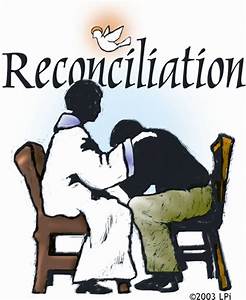
MAKING AMENDS - THE SACRAMENT OF RECONCILIATION
At the heart of the Christian Faith lies this matter of forgiveness and reconciliation.  It is, perhaps, the most crucial movement in human life and the scriptures constantly remind us of the way in which God is working to reconcile the world.  Ever since the dawn of Christianity this need for reconciliation has been realised and the sacramental life of the church has reflected this.  And whilst Baptism cleanses us of sin, we don’t stop sinning and so the Sacrament of Confession, or as it has become known the ‘Sacrament of Reconciliation’, has become, from the earliest times, part of the ministry of the church.

Whilst there are so many references in the scriptures to the need for forgiveness and reconciliation, probably the most powerful image that’s moved people to make their confession is that of the return of the Prodigal Son, which has also been called the ‘Parable of the Loving Father’.  If you’re unfamiliar with the story it concerns a young man who, having squandered his inheritance and lost all his friends, decides to return to his home and admit his mistakes. 

In the parable there are some telling phrases, the first of which is connected with why penitents ask – confidently – for God’s blessing.  As the repentant son turns to home Jesus says this:  But while he was still far off, his father saw him and was filled with compassion; he ran and put his arms around him and kissed him.’ (Lk. 15:20)

It’s this deep compassion – love – that the father had for his son that is activated as the son makes that first step to return that means God will bless all those who seek forgiveness for their sins.  Who seek reconciliation. 

The other interesting phrase Jesus uses is this: when he came to himself’ (Lk. 15:17).  There is something about sin which is unnatural.  We were not created for sin even though it has power over us.  Or, to put it another way, we can be drawn away from that which we were created to be and be enticed by its opposite.  For sin is the corruption of our good nature.  When we sin we are ‘not ourselves’. 

In religious terms, to be ‘ourselves’ is to live in the freedom that comes as we seek at-one-ness with God.  And so the penitent kneels before the priest and the priest encourages them:  The Lord be in your heart and on your lips that you may rightly and truly confess your sins, in the name of the Father, and of the Son + and of the Holy Spirit” 

Making your confession – being open and honest – may be a blessing in disguise, but it’s a costly blessing.  After all, sin has a price.  And so, with such encouragement, the penitent begins to open their heart:
“I confess to almighty God
and before the whole company of heaven,
that I have sinned through my own fault,
in my thoughts and in my words,
in what I have done and in what I have failed to do.”

But, hang on, you might say, ‘I don’t need to confess to anyone except God, and I certainly don’t need to confess to the saints!’  Well, that’s true, to an extent.  The problem, as I wrote in my book, is that sin isn’t a personal matter between you and God: it disrupts the whole fabric of the universe.  Like throwing stones in a pond, the ripples move out and disturb the water.  And not just on the surface. 

My sin affects earth and heaven, if you like, and I need to acknowledge that and realise that the effects of what I do, ‘in my thoughts and in my words, in what I have done and in what I have failed to do’, can have a far wider effect than I might realise.  It’s what has been called the ‘Kicking the Cat’ syndrome – and if you’re not sure what that means, have a word with me afterwards!

And we can’t always make amends for our sin.  OK, sometimes we can.  We can apologise to the ‘cat’, or ask forgiveness of someone, do something to right a wrong and so on.  But so many times it’s impossible to right all the consequences of what we have done, even if we are aware of them.  So the penitent ends their confession with the words:
“For these and all the other sins that I cannot remember
I am heartily sorry, firmly mean to do better,
most humbly ask pardon of God
and of you, father, penance (advise) and absolution.  Amen.” 

Contrition for what we have done and a real desire to amend one’s life must be part of the process.  Confession isn’t just about finding forgiveness; it’s also about desiring to change one’s life.  It’s part, if you like, of the conversion process.

Many of us might say that we only sin ‘a bit’, but the truth is that all sin has its effect on others and in order to right our relationships with the world around us we need to be in a right relationship with God.  And that is where the Sacrament of Confession is so helpful.  To say ‘sorry’ to God in the presence of another human being has a different effect on me than if I only have to do so in my heart. 

I have to face the truth of my sin when it is out there, in the open (as it were).  When we have admitted that which has wounded our relationship with others and with God and, in a real sense, wounded us. 

CONCLUSION
So we lay it all out before God in the presence of another human being.  But that human being, in his or her priestly role, is Christ-like.  And then, finally, the confessor assures the penitent of God’s forgiveness:    
“Our Lord Jesus Christ, who has left power to his Church
to absolve all who truly repent and believe in him,
of his great mercy forgive you your offences;
and by his authority committed to me,
I absolve you from all your sins, in the name of the Father,
and of the Son + and of the Holy Spirit.  Amen.
Go in peace; the Lord has put away your sins,
and pray for me, a sinner too.”

There’s something immensely liberating in those words, “I absolve you”.   It can feel like a great weight has been removed and, whilst none of us can be set free from the consequences of our sin that awful burden of guilt can be lightened. 

As we approach the coming of Christ you might consider whether making your confession has its place in your Christmas preparations.  God has given every priest authority to give absolution – it might just be your most important present to the world – and yourself.

Sunday, December 01, 2019

SERMON FOR FIRST SUNDAY IN ADVENT 2019


Preached at the Church of St. John the Baptist, Eltham
at Parish Mass on December 1st, 2019


 ‘Salvation is nearer to us now
than when we became believers.’

X

INTRODUCTION

So, once again, we begin the Season of Advent – four weeks of waiting and preparing to celebrate the enfleshment – the in-breaking of God – into our world.  Each year we return to this theme, and those of us who’ve celebrated this event many times may wonder at the way it all comes round again so quickly.  Is there anything more one can say or anything more to experience?

Well, yes, of course there is.  Until we welcome Jesus when he returns; until we see him face to face; until we know him and greet him as our saviour; until we realise him in everyone we encounter; until our hearts have become His home we need these weeks to reflect on how we will respond to his coming.

This year it’s Matthew whose writings announce this new Year of Grace; whose Gospel will open to us the mysteries of Christ throughout Ordinary Time.  The writer may have been that tax collector whom Jesus called, but we cannot know for sure.  Many see in his writings the hand of a thinker aware of the debates within Judaism in the period when he wrote – possibly between AD 80 and 100 – who wanted to present the person of Jesus as the fulfilment of His religion.  Jesus is the one in whom the Reign of God reveals itself – the one whom the prophet Isaiah spoke about: O house of Jacob come; let us walk in the light of the Lord! (Is.2:5)  Certainly, his gospel gives us far more of the words of Jesus than any of the others and someone called Papias (c.60 - 163 AD), one of the earliest Church historians, records that "Matthew collected the sayings of Jesus in the Hebrew tongue."  What, then, of today’s gospel reading as we begin this new year? 

THE COMING OF MESSIAH
Well, firstly it recounts the way Jesus reflected on the end of the old world with the coming of the Messiah, the anointed one, who would herald a new order.   Reading through this passage takes me back to walking on the Mt. of Olives in Jerusalem and looking out over the Dome of the Rock and the Old City. 

It’s a remarkable sight made the more startling by the fact that the best view is from the vast Jewish cemetery on the eastern slopes of the Kidron Valley, facing an equally enormous Muslim cemetery on the other side.  And the reason why these cemeteries exist is because both Jews and Muslims share the same faith – the faith that we, Christians, also proclaim – that the Messiah will return to Jerusalem to begin this new world order.  It’s something we affirm each time we recite the Creed – the ‘official’ statement of our Christian Faith: He will come again in glory to judge the living and the dead, and his kingdom will have no end.’

Now I realise how the question of our being judged can raise problems.  Most of us don’t like being judged, and some (often the same people) are quick to judge others.  Yet the great religions of Judaism, Christianity and Islam all affirm that there will be a judgement at the end of time.  And whilst it may be uncomfortable to have to include this as a statement of Faith, it’s nonetheless a corrective to that thinking which speaks of rights and not responsibilities; where many feel they can ‘get away’ with lying, misrepresentation and wrong-doing without recognising that there’s a price that will have to be paid.  When, in what is being called a ‘Post-truth’ society, some believe they have a right to stir up fear and hatred without bothering with the consequences which often means suffering for others.  In the end it’s only Satan, the master of deceit, who benefits.  So, at this time of discerning for whom we should elect to parliament, the honesty, truthfulness and integrity of candidates must inform our choice.

THE JUDGEMENT OF GOD
Now one of the great traditions of Advent is to consider what are known as the ‘Four last Things’ – Death, Judgement, Heaven and Hell - as we prepare for the coming of the Christ.  Whilst for many this pre-Christmas season is about the fripperies of it all – chocolate Advent calendars, putting up the decorations and buying the presents – the Church asks us to consider the real consequence of the advent of God among us.  These four weeks are meant to be a kind of ‘wake-up’ call; a time when we take stock of our lives and consider how we would respond when we meet God face to face.  How, as we encounter a new day, we might cloth ourselves in the garments of Christ.  And then how we would react to having our lives laid out before him. 

And none of us have lived blameless lives.  None.  So Advent, like Lent, is a season for repentance (which is why the colour of the season is purple) and why we are urged to make our Confession as we prepare to welcome Christ.  I mentioned that last week because the Sacrament of Confession is one many Anglicans ignore but which is a real means of deepening our relationship with God – and offers a corrective to the way we can ignore our sinfulness – it is a means of cleansing our lives and starting again each time we seek absolution.

THE JUSTICE OF GOD
But lest we consider the One before whom we kneel for forgiveness is a stern, condemning judge we need to remember that His nature is to be merciful and compassionate.  I ‘ve come to realise that this matter of judgement is for my good – that God wants me to see myself as I truly am so I can face up to the truth of myself.  And, in so doing, seek to be remade and re-clothed in those garments which will help me to live in the light of Christ – the armour of light, as S. Paul says.  That’s something which makes Christianity unattractive for some, for the coming of God in human form is to enable us to be remade in His image and likeness.  ‘O God, you search me out and know me’ wrote the psalmist.  God searches us out to ‘find’ us – help us become the real person we are being created to become.

I have always been saddened by the knowledge that not everyone wants to grow up.  Growth, as we all know, means change, yet some have stopped growing.  They have become trapped – and that applies to Christians as well.  Too many of us have settled for less than God wants for us.  So to all of us Paul says those words: ‘now is the moment for you to wake out of sleep.  For salvation is nearer to (you) now than when you first became (a) believer.’ 

But salvation, of course, depends on our realising that we need to be saved – saved from our past and present errors, saved from settling for less than we can be; saved from our tendencies to turn from light and life.  Saved from sin, our turning from God.  Salvation is what God offers us through the coming of the babe of Bethlehem, who is also our Judge.  As a priest I once knew said in a sermon:

“Judgement is not so much something that happens in the future, but rather something that happens all the time.  In S. John’s Gospel Jesus says: ‘this is judgement, that he light has come into the world, and men loved darkness rather than light because their deeds were evil.So, in our heart of hearts, we know we judge ourselves daily by the choices we make;   one way or another we all choose between light and darkness, good and evil, love and selfishness.  Day by day these may well seem very small choices of no great significance, but by these choices we build up our personal histories and we choose which side was shall take at the end of the day.  Ultimately we are built up or diminished by these apparently insignificant choices.”  

Soon we will be attending to the message of your heavenly Patron who, recognising that God’s coming was close, cried: ‘Repent, for the Kingdom of God is at hand!’  The message is the same; we need to turn around and face the light of God, our merciful judge, that is constantly shining upon us.  Need to turn around – repent - and confess our sins to the One who is all-merciful.  And then to wrap ourselves up in the clothing of Christ so that we can say, with S. Paul:

‘it is no longer I who live but Christ who lives in me.’ (Gal.2:19f)

For at the end of this year, as the leaves fall and the frost creeps over the land, we're invited to awaken to the coming of Christ.

He will come like last leaf’s fall.
One night when the November wind
has flayed the trees to bone, and earth
wakes choking on the mould,
the soft shroud’s folding.

He will come like frost.
One morning when the shrinking earth
opens on mist, to find itself
arrested in the net
of alien, sword-set beauty.

He will come like dark.
One evening when the bursting red
December sun draws up the sheet
and penny-masks its eye to yield
the star-snowed fields of sky.

He will come, will come,
will come like crying in the night,
like blood, like breaking,
as the earth writhes to toss him free.
He will come like child.

– Bp. Rowan Williams, An Advent Meditation

Sunday, December 02, 2012

THE SOUL'S DESIRE


FIRST SUNDAY IN ADVENT (Yr. C)
Sermon preached in the Church of All Saints, New Eltham
at Parish Mass on Sunday, 2nd December, 2012

‘Be alert at all times,
praying that you may have the strength to escape all these things
that will take place, and to stand before the Son of Man.’ (Lk.21:36)
X

INTRODUCTION
Once again, we begin a new Christian Year with the season of Advent when we prepare for the coming of the Lord.  The somewhat ominous message of our gospel reading, in particular, is a salutary reminder that such preparation is more than making sure the cards are written and presents bought. 

Yet is the consequence of our praying ‘thy kingdom come’ really going to be like a divine disaster movie?  Is this what we really desire and long for: what my heart must be set on as we prepare for the coming of God?  No wonder it seems better to focus into more cuddly things – babies and mangers, Christmas trees and fairy lights.  As John Betjeman wrote in one of his poems:

And is it true?  For if it is,
No loving fingers tying strings
Around those tissued fripperies,
The sweet and silly Christmas things,
Bath salts and inexpensive scent
And hideous tie so kindly meant,

No love that in a family dwells,
No caroling in frosty air,
Nor all the steeple-shaking bells
Can with this single Truth compare—
That God was Man in Palestine
And lives today in Bread and Wine.

What needs to lie at the heart of our preparations for the coming of a God is the realisation that God desires to be at-one with us and expresses this every time He makes Himself present through the Eucharist.  The prayer of the ‘heart’s desire’ is to want to allow God into the depths of our being.  That’s the essence of prayer, something I want to share some thoughts about on two Sundays during Advent.  This morning I’ll focus into some of the more common aspects and next time explore what we mean by meditation and contemplation.

WHAT IS PRAYER?
Now, if you were to ask most people what they understood the word prayer to mean they would, probably, say ‘asking God for things’ or, with any luck they might add ‘and thanking God for things’, or even ‘listening to God’.  And all these things are aspects of prayer, for prayer concerns the ‘inclination of the heart to God’.  At its most simple prayer simply involves giving time and attention to the desire of the heart to be at one with God.  So let’s see how the Eucharist can help us re-imagine our prayer.

COMMON PRAYER – THE EUCHARIST
Common prayer, or the Liturgy – the work – of the Church, helps our relationship with God to develop.  We come to church and sing hymns, listen to readings, offer our intercessions and make our Communion in the Body and Blood of Christ.  Hopefully, through all this, we are moved into a deeper union with God.  The ‘heart’ of who we are (not the physical heart but the centre of our being) is re-fashioned as we open our inner being, our heart, to the desire of God for at-oneness with us. 

When I was learning the Faith I was taught that one should prepare to receive Holy Communion.  I was encouraged to remember my Communion throughout the week and spend time the night before preparing by prayer and fasting.  Then when I first entered a church I should pray – something with the passing of time it’s easy to forget.  Yet if we stopped to pray that would be a reminder we are called, before we attended to our jobs or our friend, to Love God with all our heart, mind and strength’.  And, remember, the essence of prayer is the inclination of the heart to God.  As one of my Franciscan brothers used to say: ‘Get it right with God first, brother!’  Coming to church wasn't to be like visiting Tesco:  this is the House of God and the Gate of Heaven and everything here is designed to move the heart towards God.  If we have the eyes to see. 

There’s a story about the late Orthodox Archbishop Anthony Bloom I’d like to share with you.  One day a young man, new to the church, asked Archbishop Anthony what books he would need when he came to the church.  Instead of giving him a copy of the service Anthony said this: ‘Come and let your eyes see us.  See how we worship.  Then, come and watch our faces.  After that, take a service book and learn the words you need to use by heart, but never bring it with you!’ 

Perhaps, as someone once remarked to me, we ‘westerners’ are too attached to our books…

COMMON PRAYER – THE DIVINE OFFICE
Another means of prayer that many find of great help is what is known as the Prayer of the Church or the Daily (or Divine) Office.  Priests have to pray the Office of Morning and Evening Prayer daily and others find some form of such prayer to be of great value.  Consisting mostly of psalms and readings, the Office is a simple way of praying with scripture.  And immersion in scripture helps form our prayer.  Whilst it may be helpful to do that in church, most do so at home or even on the train to work.  It’s a great way to begin the day as it means we are giving attention to Jesus’ primary command.  But whatever we do, we need to get into the habit of prayer in our daily lives. 

CONFESSION          
Right at the beginning of the Eucharist we are invited to confess our sins by making a General Confession.  Some realise this needs to be personalised and have developed a practice of regular Confession to a priest.  Now the Sacrament of Confession is often neglected in the Church of England, but it is something available to all for all of us sin and need to be reconciled with God and our neighbour. 

The Anglican dictum concerning this Sacrament is, ‘all may, none must; some should’ and many find that making their confession at regular intervals is of great help in developing a right relationship with God.

PRAYER AS INTERCESSION
Only later in the Eucharist do we come to prayer for others, that prayer we call Intercession. Yet for many this is the only prayer they practice.  ‘Please help Johnny!’; ‘Don’t let Mary suffer!’; ‘Help Peter pass his exams.’  These are more rightly called ‘arrow’ prayers – shooting an arrow of desire to God.  

Or we might make ‘ejaculatory’ prayers; prayer that suddenly arises from some moving experience which may be silent or, at times, spoken aloud. Both might be called involuntary prayers which emerge from movements within the heart.  But they are dependent on circumstances outside of ourselves. 

A RULE OF LIFE
And it’s for that reason another way people find help in putting their relationship with God at the centre is by developing what is known as a Rule of Life.  A Rule sets out the norms by which we are called to live.  So, apart from matters like a pattern of prayer and attendance at Mass, it will also act as a reminder of how we give attention to charitable giving, and how we feel called to serve others – not least our families, partners and friends.  And for people who are very busy it’s a good way of making sure we set aside time for ourselves!

SPIRITUAL DIRECTION
But all who are seeking to give attention to God recognise they need help and so the tradition of Spiritual Direction has developed since the earliest centuries.  Spiritual Direction is an on-going process whereby an individual, with the aid of a more experienced guide, explores a deeper relationship with themselves, the world around them and with God.  

IMAGES OF GOD AFFECT OUR PRAYER
But our image of God will affect the way in which we respond to our approach to prayer.  If our image of God is rooted in a distant father, or in one who was harsh with us whom we came to fear, or if we lacked love in our earliest years or have a poor sense of our own worth and value, that will affect our approach to God.  Thoughts of the coming of the Son of Man ‘in a cloud with power and great glory’ may then fill us with fear and anxiety.  Yet, if we embrace the image of His coming as the coming of our Divine Lover who seeks to re-make us in His image, then we can ‘stand up and raise ()our heads, because ()our redemption is drawing near.’ 

CONCLUSION
Next time I want to spend time reflecting on the place of meditation and contemplation in our life of prayer and there’s a leaflet inside the December magazine which, I hope, will be of help.  ‘When I prayed I was new’, wrote one great Orthodox guide, ‘and when I stopped praying I was old.’  ‘Prayer’ wrote another, is ‘the habit of being in the presence of the thrice-holy God and in communion with him, … the elevation of the soul to God.’ 

This matter of prayer is of fundamental importance to people of all faiths yet is daunting for many of us.  Yet it is as easy and as basic as breathing.  Rather than something to leave to ‘experts’, prayer is the very atmosphere in which we are called to live.  ‘For me’ wrote S. Therese of Lisieux, ‘prayer is a surge of the heart; it is a simple look turned toward heaven, it is a cry of recognition and of love, embracing both trial and joy.’  So may this Advent be a time when we pray and live the Eucharist – seeking reconciliation; centring on the Word of God; holding the world before Him; offering daily our sacrifice of praise and thanksgiving as we seek to venerate Christ beneath all outward things.  This is the Prayer of Eucharistic Living as we open our hearts to the One who seeks and desires us.    

Tuesday, December 20, 2011

O Clavis David


What was happening in this space was life-forming in darkness.  A new Creation, one not-known, unseen, the merest stirring of something new.  No scans for Mary!  Nothing but waiting.  What had she said ‘yes’ to?  What would this new life be like (and even when it came and for many years to come it would be no more unique than any other life-form).  Our saying ‘yes’ to God can only be done in faith and trust without any certainty as to what exactly we have said yes to.  Hindsight is never given in advance…  We must wait, as Eliot said, without hope … without thought and when those come, which they must, we must learn to set them aside for, what is important, what is essential, is that the darkness shall be the light, and the stillness the dancing.  This seemingly pointless waiting is the space in which God is creating.  It is that point between God and Man of apparent nothingness, that vacuum which must abhor intrusion for it is that still-dark formless time before the new-first light-filled day. 

Yet one longs for that day to come, quickly.  O Come, O Come!  Our human nature abhors this vacuum – only Grace can fill this emptiness. 

Hail, full of Grace, the Lord is with you!

This waiting-space is to be grace-filled by the One who has invited us to say our fiat


Sunday, November 27, 2011

ADVENT SUNDAY - A PERSONAL REFLECTION


'Unto you, O Lord, have I lifted up my soul; O my God, I trust in you, let me not be put to shame; do not allow my enemies to laugh at me; for none of those who are awaiting you will be disappointed.’ Psalm 25:1-3

So pleads the Introit at Mass today, Advent Sunday.   The words speak to me of that sense of waiting for something as yet unknown that can only be discovered as, with trust, I ‘lift up my soul’ to God.   Later, words might come as to what is awaited: come God’s Wisdom; Come, O Dayspring; Emmanuel, the Desire of all the Nations.  Come.  But such invocations do not form as yet.  For the present time of waiting there is but this sense that I must lift my soul to the Lord.  Now is not the time to sing veni, veni Emmanuel, but to allow this blind yearning until such time that words form and give voice to what is desired.

Having spent more than thirty-five years within the ark of words, of structures and forms, I now need to find those words for myself.  On Radio 4 there is a programme called ‘Something Understood’: at present I no longer understand, rather I wait for something dimly sensed.  Felt.  That that thing is God I have no doubt.  But what will that experience of God be like?  Perhaps Eliot expresses it best:

And what you thought you came for is only a shell
Is only a shell, a husk of meaning
From which the purpose breaks only when it is fulfilled
If at all. Either you had no purpose
Or the purpose is beyond the end you figured
And is altered in fulfilment.

And so I, and the Church, wait as we have done for two thousand years, for the in-breaking of God. For that fulfilment of a dimly-sensed desire which only God can satisfy.  And what that ‘coming’ will be like God alone knows.  That is His gift and His promise.  For the time being I can but trust that, as I turn the eyes of my heart to God, this winter of longing and waiting will prove the soil of new life.